Treated by Dr. Ravi Chandra Reddy Obili at Dr Ravi Chandra Reddy
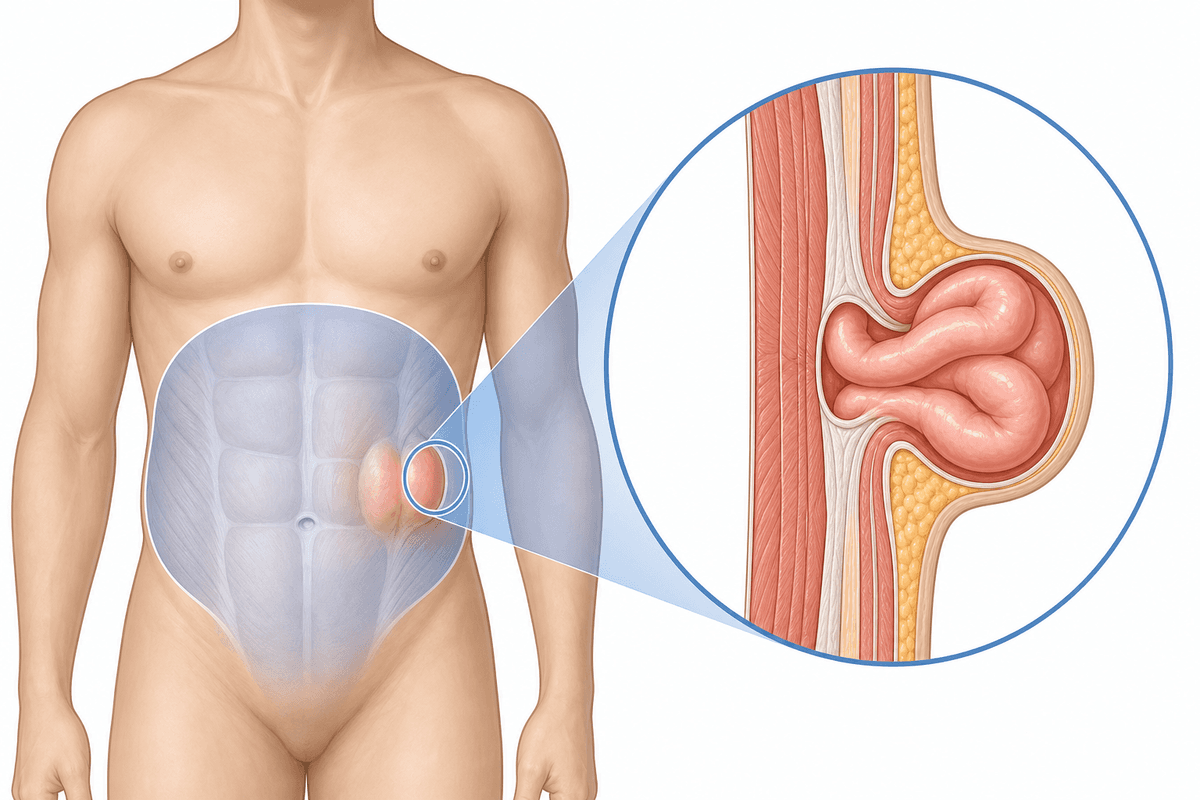
Abdominal wall hernia in Visakhapatnam occurs when internal organs or tissues protrude through weakened areas in the abdominal muscle wall, creating a visible bulge. These hernias can develop due to various factors including muscle weakness, injury, or strain, and often require surgical intervention for proper repair. Dr Ravi Chandra Reddy Obili, a specialist Surgical Gastroenterologist, provides comprehensive evaluation and advanced treatment options for all types of abdominal wall hernias.
Develops at the site of a previous surgical incision where the abdominal wall has weakened. Common after major abdominal surgeries, particularly when healing is compromised by infection, obesity, or excessive strain on the incision site.
Occurs near or through the belly button when abdominal contents push through a weak spot in the umbilical area. More common in infants but also affects adults, particularly women after pregnancy or individuals with increased abdominal pressure.
Forms in the midline between the belly button and breastbone through small gaps in the abdominal wall. Usually contains fatty tissue but can include portions of the intestine, causing discomfort and a visible lump in the upper abdomen.
Multiple factors can contribute to the development and progression of this condition.
Abdominal wall hernia develops gradually. Recognising symptoms early gives you more treatment options.
From conservative to surgical — we always start with the least invasive option first.
A structured, patient-first approach from first visit to full recovery.
Dr Ravi Chandra Reddy Obili conducts a thorough physical examination to assess the hernia size, location, and reducibility, followed by detailed imaging studies including ultrasound or CT scan to evaluate the extent of the defect and plan the most appropriate surgical approach.
Based on the hernia type, size, patient's overall health, and lifestyle factors, Dr Obili develops an individualized treatment strategy, discussing all available surgical options including laparoscopic and open techniques, explaining the benefits and risks of each approach.
Dr Ravi Chandra Reddy Obili performs the hernia repair using state-of-the-art surgical techniques and high-quality mesh materials, prioritizing minimally invasive laparoscopic methods when appropriate to ensure optimal outcomes with faster recovery and minimal scarring.
Comprehensive follow-up care includes pain management, wound care guidance, gradual activity progression protocols, and regular monitoring to ensure proper healing, prevent complications, and support patients in returning to their normal activities safely and effectively.
What to expect at each phase of recovery.
Patients experience mild to moderate discomfort managed with medications. Rest is emphasized with gentle walking encouraged to prevent blood clots. Laparoscopic patients typically go home within 1-2 days, while open repair may require 2-3 days hospitalization. Light activities only with no lifting.
Gradual return to daily activities with continued lifting restrictions. Pain significantly decreases, and patients can resume light work and driving. Wound healing progresses well with proper care. Follow-up appointments ensure proper recovery without complications. Avoid strenuous activities and heavy lifting.
Full return to normal activities including exercise and heavy lifting is permitted after clearance from Dr Obili. The mesh integrates fully with surrounding tissue, providing long-term strength to the abdominal wall. Final assessment confirms successful repair with minimal recurrence risk.
Modern mesh repair techniques achieve success rates exceeding 95% with significantly reduced recurrence compared to non-mesh repairs. Laparoscopic approaches offer comparable or superior outcomes to open surgery with added benefits of faster recovery and reduced complications.
Patients undergoing laparoscopic repair typically return to work within 2-3 weeks and resume full activities by 6 weeks. Open repair requires slightly longer recovery of 4-6 weeks for work and 8-12 weeks for unrestricted activities, depending on hernia complexity.
Successful hernia repair eliminates chronic pain, discomfort, and activity limitations, allowing patients to engage in work, exercise, and daily tasks without fear of complications. The cosmetic results, especially with laparoscopic surgery, are excellent with minimal visible scarring.
With expert surgical technique and proper patient selection, complication rates remain low. Infection occurs in less than 2% of cases, chronic pain affects 1-3% of patients, and recurrence rates are under 5% with modern mesh techniques when performed by experienced surgeons.
Untreated abdominal wall hernias progressively enlarge over time, leading to increased pain, discomfort, and functional limitations in daily activities. The most serious risk is incarceration where the hernia contents become trapped and cannot be pushed back, potentially leading to strangulation where blood supply is cut off, causing tissue death and requiring emergency surgery. Delayed treatment of complicated hernias results in more complex surgeries, longer recovery times, and increased risk of complications compared to elective repair of uncomplicated hernias.
You should seek immediate medical attention if you experience sudden severe pain at the hernia site, nausea, vomiting, inability to pass gas or have bowel movements, or if the bulge becomes hard, tender, red, or discolored, as these may indicate strangulation requiring emergency surgery. For non-emergency situations, consult Dr Ravi Chandra Reddy Obili if you notice any new bulge or lump in your abdominal wall, experience persistent discomfort or pain in the abdomen, or have a known hernia that is increasing in size or causing symptoms that interfere with your daily activities.
Early treatment means more options and better outcomes. Book a consultation to understand your condition and explore the right path forward.