
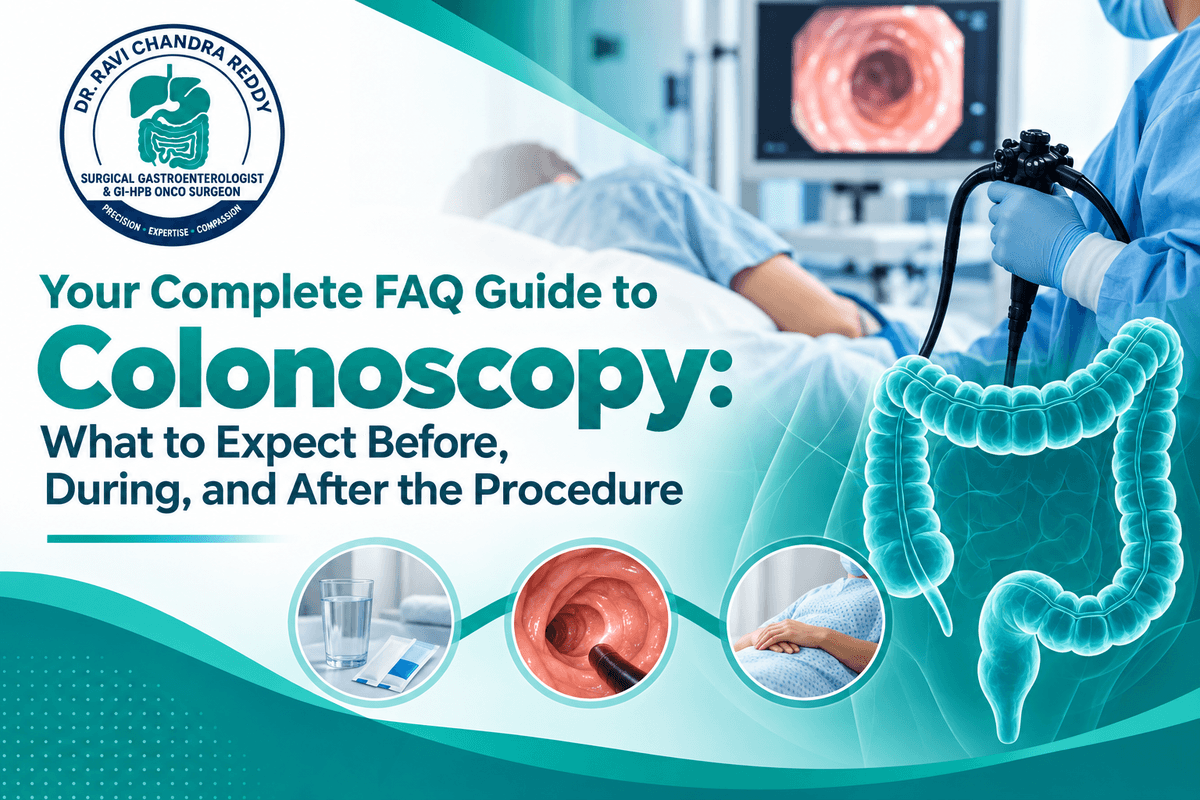
Your Complete FAQ Guide to Colonoscopy: What to Expect Before, During, and After the Procedure
By Dr. Ravi Chandra Reddy Obili, Gastroenterologist — Krishna Nagar, Visakhapatnam
Are You Putting Off a Colonoscopy Because You Don't Know What to Expect?
You've been told you need a colonoscopy. Maybe your doctor mentioned it at your last check-up, or you've been experiencing persistent bloating, changes in bowel habits, or unexplained rectal bleeding. And now, the word "colonoscopy" is sitting in the back of your mind — accompanied by a mix of worry, questions, and let's be honest, a fair bit of dread.
You're not alone. Thousands of patients across Visakhapatnam — from Maharanipeta to Dwaraka Nagar to Krishna Nagar — delay or avoid this critical procedure simply because they don't know what it involves. Fear of the unknown is often worse than the procedure itself.
Screening colonoscopy and polypectomy are the cornerstone in decreasing the incidence and mortality of colorectal cancer. Yet in India, awareness and uptake remain dangerously low. This guide is written to change that — by giving you clear, honest, medically accurate answers to every question you've been afraid to ask.
What Exactly Is a Colonoscopy and Why Does It Matter?
A colonoscopy is a safe, minimally invasive examination that allows your gastroenterologist to look inside your large intestine (colon) and rectum. During a colonoscopy, a long, flexible tube called a colonoscope is inserted into the rectum. A tiny video camera at the tip of the tube allows the doctor to detect changes or abnormalities inside the entire colon.
This is not just a cancer test — it is also a cancer prevention tool. If polyps or abnormalities are found, they can often be treated or removed during the procedure. Small tissue samples may be taken for biopsy if needed. Most polyps are non-cancerous.
Colon polyps are common in adults and are harmless in most cases. However, most colon cancers begin as a polyp, so removing polyps early may help prevent cancer.
Colonoscopy has a sensitivity of 95% and specificity of 86–89%, with proven efficacy in reducing colorectal cancer mortality in multiple cohorts and trials.
When detected early, colorectal cancer is a relatively curable illness with a 90% survival rate. That single statistic is reason enough to stop postponing that appointment.
How Dr. Ravi Chandra Reddy Obili Makes Colonoscopy Comfortable and Reliable in Krishna Nagar
Patients visiting our gastroenterology clinic in Krishna Nagar, Visakhapatnam — including those coming from nearby Maharanipeta and surrounding localities — receive a thorough pre-procedure consultation before any scope is introduced. Dr. Ravi Chandra Reddy Obili personally reviews your symptoms, medication history, and risk profile to determine the most appropriate bowel preparation protocol and sedation plan for you.
Here's what the experience looks like at our clinic:
Before Your Procedure: Two to three days before your procedure, you switch to a low-fiber diet. The day before, you'll move to clear liquids like broth, water, and plain gelatin. A clean colon allows your doctor to clearly see and remove polyps. Incomplete prep may require repeating the procedure. Our team provides written, Telugu-language-friendly prep instructions so nothing is left to confusion.
During the Procedure: The procedure itself usually takes 15 to 30 minutes. You'll receive sedation so you'll be comfortable. Most patients at our Krishna Nagar clinic describe the experience as far gentler than they expected.
After the Procedure: After a colonoscopy, the sedatives or anesthesia take time to wear off. You'll stay at the hospital or outpatient centre for about 30 to 60 minutes after the procedure. You may feel cramping in your abdomen or bloating during the first hour. Results are often shared with you the same day.
We ensure every patient from Maharanipeta, Visakhapatnam, and surrounding areas leaves with a clear understanding of their results and a follow-up plan if needed.
The Evidence: Why You Shouldn't Wait
Despite the low incidence of colorectal cancer in India, there has been a rising trend in the incidence of colonic polyps and cancer over the last decade.
Among those eligible for screening colonoscopy in India, only 7.14% actually underwent the procedure — a deeply concerning gap in preventive care. Most patients who need this procedure are simply unaware of its importance or are too anxious to take the first step.
A polyp can take 10–15 years to grow into cancer. Early screening can catch them before they have a chance to develop into cancer.
All individuals with average risk should undergo colorectal cancer screening between 45 and 75. Meanwhile, individuals with higher risks, such as those with a positive family history, should begin screening at age 40.
The rate of colon cancer cases has been rising among younger people, ages 30 to 50, for reasons that are still unclear — making timely screening more important than ever for working-age adults across Visakhapatnam.
Dr. Ravi Chandra Reddy Obili brings specialist-level gastroenterology expertise to Krishna Nagar, ensuring that residents of Visakhapatnam — including those in Maharanipeta — have access to world-class diagnostic care close to home.
Frequently Asked Questions About Colonoscopy
1. Is a colonoscopy painful?
No — most patients feel little to no pain. You can have general anesthesia or conscious sedation — in either case, you probably won't remember the procedure much afterward. You will not feel polyp removal. Any mild discomfort such as bloating or gas typically resolves within the first hour after the procedure.
2. How long does a colonoscopy take from start to finish?
The entire visit takes roughly 2–3 hours, but the procedure itself is short. The procedure itself usually takes 15 to 30 minutes. Most appointments take between 30 and 60 minutes including recovery time. You will need someone to drive you home afterward due to the sedation used.
3. What can I eat after a colonoscopy?
Start with clear liquids and soft, easy-to-digest foods. Most people can eat as soon as they recover from anaesthesia after a colonoscopy. However, avoid foods that can irritate your gut for at least 24 hours — these include whole grains, raw fruits and vegetables, nuts, seeds, and greasy or fried foods. Most people can resume their normal diet within a day or two. For Indian patients, light khichdi, curd rice, or plain dal-rice are excellent options to start with.
4. At what age should people in Visakhapatnam and Maharanipeta get a colonoscopy?
Age 45 is the recommended starting point for average-risk adults. Recent screening guidelines recommend that anyone with an average risk of developing colorectal cancer should be screened starting at age 45. Individuals with higher risks, such as those with a positive family history, should begin screening at age 40. If you live in Maharanipeta, Visakhapatnam, or any of the surrounding neighbourhoods and are approaching or past this age, speak to a gastroenterologist without delay. Colonoscopy is recommended every 10 years for average-risk individuals and every 5–10 years for high-risk individuals.
5. What are the risks of a colonoscopy and are serious complications common?
Serious complications are rare, and the benefits far outweigh the risks for most patients. Rare complications may include bleeding from the site where a biopsy was taken, or a polyp or other abnormal tissue was removed, or bleeding from a tear in the colon or rectum wall. Cramping or bloating might occur afterward. Your gastroenterologist will review your individual health history to assess any specific risks before the procedure is performed.
The information in this blog is for educational purposes only and does not substitute professional medical advice. Please consult Dr. Ravi Chandra Reddy Obili or a qualified gastroenterologist for personalised guidance.
Visit Us
Visit Ravi Chandra Reddy Obili - Gastroenterologist for trusted, compassionate care. We're here for you and your family.
Ravi Chandra Reddy Obili - Gastroenterologist
Krishna Nagar, Visakhapatnam, Andhra Pradesh
Phone: 917337422216
Website: drravichandrareddygastrosurgeon.com
Google Maps: https://www.google.com/maps/place/?q=place_id:ChIJz1HwTwBpOToRjUbDE0b-PrM
Email: help@drravichandrareddygastrosurgeon.com