
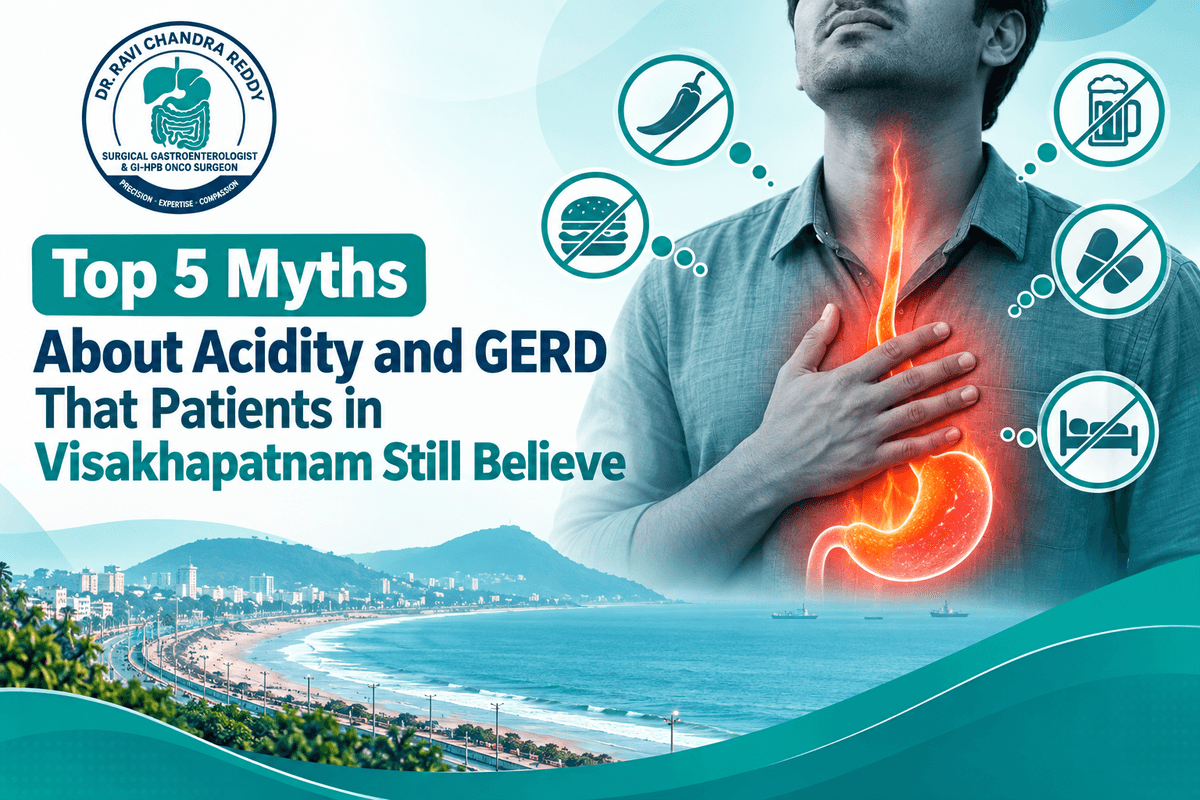
Top 5 Myths About Acidity and GERD That Patients in Visakhapatnam Still Believe
By Dr. Ravi Chandra Reddy Obili | Gastroenterologist, Krishna Nagar, Visakhapatnam
The Burning Question Most Patients in Vizag Are Getting Wrong
Picture this: a 38-year-old IT professional from Maharanipeta finishes a late dinner, pops an antacid from the kitchen shelf, and goes to bed — only to wake up at 2 AM with a burning chest and a sour taste in the throat. He dismisses it as "just gas." His wife from the same neighbourhood has been suffering the same symptoms for three years and believes cutting out spicy gongura pickle will eventually fix everything on its own.
Sound familiar?
Across Krishna Nagar, Maharanipeta, and the wider stretches of Visakhapatnam, patients walk into our gastroenterology clinic every single week carrying the same dangerous misconceptions about acidity and GERD (Gastroesophageal Reflux Disease). These myths are not harmless. If these symptoms appear more than twice a week, it could be a sign of GERD — a chronic condition that not only affects daily comfort but can also lead to long-term complications. And yet, most patients delay proper treatment by months, sometimes years, because of beliefs that simply aren't backed by science.
It's time to set the record straight.
What Is GERD, and Why Is It a Bigger Problem Than You Think?
GERD is marked by the frequent occurrence of stomach acid flowing back into the esophagus, causing symptoms such as heartburn and acid regurgitation at least once a week. It is not just an occasional discomfort after a heavy meal — it is a chronic, progressive condition.
The pooled prevalence of GERD in the Indian population is 15.6%, with risk factors including age, body mass index (BMI), non-vegetarian diet, tea/coffee intake, tobacco, and alcohol consumption. Closer to home, the prevalence of GERD was 22.2% in southern India, and was more common among older subjects and men. For a rapidly urbanising coastal city like Visakhapatnam — with its busy port workers, software professionals, and late-night street food culture — these numbers are almost certainly reflected in local patient loads.
The prevalence of GERD is higher in urban areas (11.1%) compared to rural areas (5.1%). Residents of dense, urban localities like Maharanipeta, Seethammadhara, and Krishna Nagar therefore carry a statistically higher risk than the broader population.
The problem is: most people don't take it seriously — and myths are largely to blame.
5 Dangerous Myths About Acidity and GERD — Busted
Myth 1: "Antacids Will Cure My Acidity"
This is the single most common and most dangerous myth we encounter. Patients across Visakhapatnam rely on over-the-counter antacids as a permanent solution.
The Truth: Antacids neutralize stomach acid, causing momentary relief, but they don't address the underlying causes of GERD. For long-term care, medication, lifestyle modifications, and even surgery may be required.
Worse still, while antacids offer immediate relief, their long-term or excessive use can create a paradox and potentially make GERD worse. When the stomach pH is raised, the body may respond by producing even more acid to compensate — this "acid rebound" can lead to more frequent and intense heartburn episodes.
Over-the-counter antacids and acid-reducing medicines can mask symptoms without addressing the underlying problem. Some patients use them on and off for years without ever being formally evaluated.
If you have been reaching for antacids more than twice a week for longer than two weeks, it is time to see a gastroenterologist — not the medical shop.
Myth 2: "Only Spicy Food Causes Acidity — I Just Need to Avoid Mirchi"
In Visakhapatnam, the love affair with spicy Andhra cuisine — gongura, pesarattu, and fiery fish curries — leads many patients to blame food alone.
The Truth: Spicy foods are often blamed for causing GERD, but the main cause is actually the weakening of the lower esophageal sphincter (LES), which causes stomach acid to flow back into the esophagus — though some people may have symptoms after eating spicy foods.
Laboratory studies investigating the effect of spicy food on LES pressure showed that spicy foods had little to no effect on LES pressure. This means that spicy foods have not been shown to cause stomach contents to enter the esophagus.
Some people with acid reflux can tolerate moderate amounts of spicy food without problems, while others may need to avoid them completely. The key is identifying your individual triggers through careful attention to symptoms rather than eliminating entire food categories unnecessarily.
Blanket food avoidance without a proper diagnosis is not treatment. It is guesswork.
Myth 3: "GERD Is Just Heartburn — It's Not Serious Enough to See a Doctor"
Many patients in Krishna Nagar and the surrounding areas of Visakhapatnam dismiss GERD symptoms as a "lifestyle problem" to be managed at home.
The Truth: While occasional acid reflux might resolve with lifestyle changes, GERD is a chronic condition that typically requires ongoing management. Left untreated, GERD can lead to serious complications including esophageal damage, scarring, and increased risk of esophageal cancer. Early treatment helps prevent these complications and improves quality of life.
Over time, GERD can damage the lining of the esophagus and lead to more serious health problems, including Barrett's esophagus, a pre-cancerous condition.
Most people who develop Barrett's esophagus have had gastroesophageal reflux disease (GERD) for at least 10 years. That is exactly the kind of slow, silent damage that happens when patients keep dismissing their symptoms year after year.
Myth 4: "Acidity Is Only a Problem for Older People"
A significant number of young professionals and college students in Visakhapatnam believe that acidity is an "old person's disease" and that they are too young to be worried.
The Truth: GERD does not only affect older adults — all age groups, including young children and infants, are susceptible to GERD.
According to a survey conducted in India in 2021, about 32% of adults aged 30 to 44 years old reported having acidity and indigestion problems — squarely the working-age group that dominates Vizag's growing IT parks and commercial corridors.
Age, gender, ethnicity, genetic predispositions, and aspects of diet and lifestyle — including factors like obesity and smoking — are all associated with GERD. Stress, irregular meal schedules, late-night eating, and rising obesity rates are pushing GERD increasingly into younger demographics.
Myth 5: "Stress Has Nothing to Do With My Acidity"
This myth is particularly prevalent among working professionals in Visakhapatnam's busy commercial zones, from Maharanipeta's trade establishments to the IT corridors of Rushikonda.
The Truth: Many people don't realise the connection between stress and digestive symptoms. Stress can actually worsen acid reflux by increasing acid production, slowing digestion, and affecting the lower esophageal sphincter. Managing stress through relaxation techniques, exercise, or other methods can be an important part of acid reflux treatment.
The adjusted odds ratio for GERD symptoms was 1.96 times higher in the moderate-to-high stress level group compared to the low-stress level participants. Stress nearly doubles your risk. If your symptoms consistently flare during deadlines, exams, or family pressure, stress is likely a real driver — and it must be addressed as part of any comprehensive GERD management plan.
How We Treat GERD at Our Clinic in Krishna Nagar, Visakhapatnam
At our gastroenterology practice in Krishna Nagar, we approach GERD with a structured, evidence-based protocol — not guesswork or generic advice.
Step 1 – Accurate Diagnosis First: Endoscopy is important in the diagnosis and therapeutic management of GERD. Those who present with alarm symptoms, have chronic GERD at risk of Barrett's esophagus, or have an inadequate symptomatic response to treatment will require an upper GI endoscopy for further management. We do not prescribe long-term medication without first establishing what is actually happening in your esophagus and stomach.
Step 2 – Personalised Treatment Plan: Depending on the severity of your condition — whether it is non-erosive reflux disease, erosive esophagitis, or Barrett's esophagus — we design a treatment plan that may include medically supervised acid-suppressing therapy (PPIs or H2 blockers), personalised dietary guidance, stress and lifestyle counselling, and in select cases, referral for surgical evaluation.
Step 3 – Long-term Follow-up: GERD is a chronic condition. With the right diagnosis and treatment plan, lasting relief is very achievable. We monitor your progress, adjust medications as needed, and conduct surveillance endoscopies where clinically indicated to catch any early changes before they progress.
Patients from across Visakhapatnam — including Maharanipeta, Seethammadhara, Gajuwaka, and Dwaraka Nagar — visit our clinic in Krishna Nagar for specialised gastroenterology consultations. Early evaluation is always easier, simpler, and safer than treating advanced complications.
Evidence: Why Early GERD Treatment Matters
The numbers from peer-reviewed research make a compelling case for not waiting:
- A task force set by the Indian Society of Gastroenterology found the incidence of GERD to be at least 20% in many Indian cities, which translates to an estimated 250 million people in India suffering from this disease.
- Among patients with GERD in southern India, 34.3% used medications daily for symptom relief — yet many had never been formally evaluated by a specialist.
- One of the most serious changes GERD can cause is Barrett's esophagus, from which esophageal adenocarcinoma — a serious form of cancer — can develop in cases of long-standing GERD.
- For diagnostic purposes, upper GI endoscopy boasts an accuracy rate often exceeding 95% in identifying abnormalities such as ulcers, inflammation, polyps, and early signs of cancer.
- Complication rates for Upper GI Endoscopy are remarkably low, typically less than 0.1% for major complications, making it a very safe procedure.
The evidence is unambiguous: early, accurate diagnosis leads to better outcomes, lower complication rates, and significantly improved quality of life.
Frequently Asked Questions (FAQs)
Q1: How do I know if I have acidity or GERD?
If you have acid reflux two or more times per week, you may have gastroesophageal reflux disease (GERD). Common symptoms include heartburn, regurgitation, sour taste in the mouth, chest pain, and chronic cough. Occasional acidity after a heavy meal is normal; frequent, recurring episodes need a gastroenterologist's evaluation.
Q2: Can GERD be permanently cured with lifestyle changes alone?
Lifestyle changes — including weight loss, avoiding trigger foods, eating smaller meals, and not lying down immediately after eating — significantly reduce symptoms for many patients. However, GERD can substantially reduce quality of life and predispose patients to serious complications if untreated. Most patients with true GERD need a combination of lifestyle modification and medical therapy for lasting relief.
Q3: Is it safe to take antacids every day for acidity?
While antacids can provide temporary relief for mild, occasional symptoms, they are not sufficient for managing GERD. Frequent use of antacids can actually mask symptoms of a more serious condition that needs proper medical treatment. Daily antacid use without a formal diagnosis should be a red flag — not a long-term strategy.
Q4: Where in Visakhapatnam can patients from Maharanipeta get a specialist GERD evaluation without travelling far?
Patients from Maharanipeta and the surrounding areas of Central Visakhapatnam can access expert gastroenterology care right here in Krishna Nagar, Visakhapatnam, without needing to travel to distant super-specialty hospitals. Dr. Ravi Chandra Reddy Obili offers comprehensive GERD consultations, diagnostic upper GI endoscopy, and personalised treatment planning for patients across the city — from Maharanipeta and Dwaraka Nagar to Gajuwaka and MVP Colony.
Q5: What happens if GERD goes untreated for years?
GERD, when left untreated, can result in severe, life-threatening complications. The most common is esophagitis, inflammation of the food pipe, which produces consistent burning pain and makes swallowing difficult. If left untreated, the inflammation can cause ulcers of the lining, bleeding, or both. Repeated cycles of esophagitis and healing can lead to scarring and narrowing of the tube, known as esophageal stricture. In the worst cases, it can progress to Barrett's esophagus and, in a small percentage of patients, esophageal cancer. This is why timely medical attention is non-negotiable.
Visit Us
Visit Ravi Chandra Reddy Obili - Gastroenterologist for trusted, compassionate care. We're here for you and your family.
Ravi Chandra Reddy Obili - Gastroenterologist
Krishna Nagar, Visakhapatnam, Andhra Pradesh
Phone: 917337422216
Website: drravichandrareddygastrosurgeon.com
Google Maps: https://www.google.com/maps/place/?q=place_id:ChIJz1HwTwBpOToRjUbDE0b-PrM
Email: help@drravichandrareddygastrosurgeon.com