
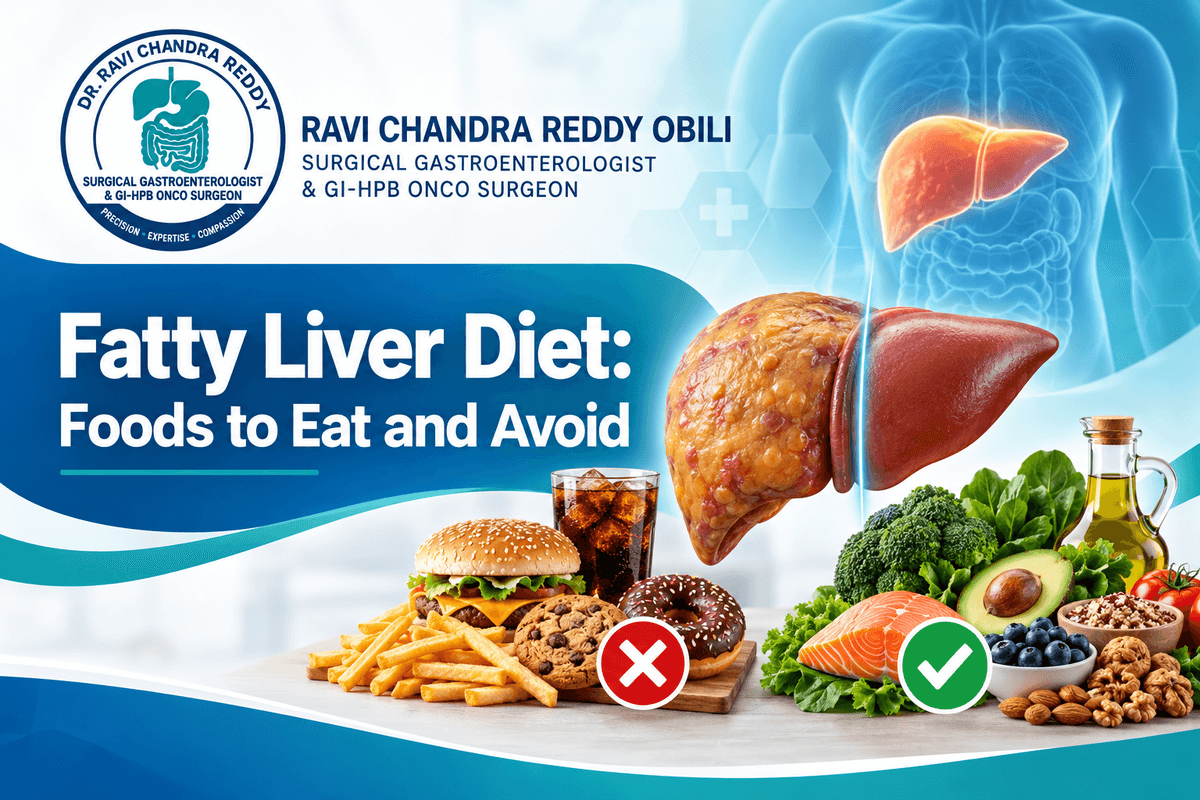
Fatty Liver Diet: Foods to Eat and Avoid
A practical guide from a gastroenterology perspective — for patients in Krishna Nagar, Visakhapatnam and across Andhra Pradesh
When Your Liver Feels the Weight of What You Eat
You may have gone in for a routine ultrasound and come out with a three-word phrase that stopped you in your tracks: fatty liver disease. Perhaps your doctor mentioned your liver enzymes were elevated. Or maybe you've been feeling persistent fatigue, a dull ache in the upper right abdomen, and unexplained weight gain — symptoms easy to dismiss but hard to ignore once they accumulate.
The unsettling truth is that fatty liver disease often has no obvious symptoms in its early stages. The disease can remain silent for years, with liver damage progressing before symptoms become apparent. Many people are diagnosed only during an investigation for something else entirely.
The question that almost every patient asks next is: "Doctor, what should I eat — and what should I stop eating?" This blog answers that question clearly, practically, and in a way that fits the way most people in coastal Andhra Pradesh actually eat.
The Direct Answer: Diet Is a Primary Treatment Tool
The AASLD (American Association for the Study of Liver Diseases) Practice Guidance on NAFLD identifies dietary intervention as a primary therapeutic strategy in the early stages of the disease. This means that what you put on your plate every day is not a complement to treatment — it is the treatment, especially in the early and moderate stages.
Non-alcoholic fatty liver disease (NAFLD) is the most common cause of chronic liver disease, without a pharmacological treatment currently approved. This makes dietary change even more consequential. There is no pill that replaces a corrected diet.
The broad principle is straightforward: follow traditional dietary patterns such as the Mediterranean diet; limit excess fructose and avoid processed foods and beverages with added fructose; replace saturated fats with polyunsaturated and monounsaturated fatty acids; replace processed food and sweets with unprocessed foods high in fibre, including whole grains, vegetables, fruits, legumes, nuts, and seeds; and avoid excess alcohol consumption.
Crucially, outcomes depend on each individual's clinical profile, degree of liver involvement, metabolic conditions like diabetes or hypertension, and body weight. A gastroenterologist's assessment comes before any blanket dietary prescription.
Foods to Eat: Building a Liver-Friendly Plate
✅ Vegetables — Make Them the Foundation
Vegetables are the foundation of a fatty liver diet. Leafy greens, broccoli, cauliflower, bell peppers, zucchini, mushrooms, and similar choices are low in calories, high in fibre, and help reduce insulin resistance. For patients in Visakhapatnam, this means freely including drumstick leaves (murungakeerai), spinach, ridge gourd, and bitter gourd in daily cooking.
✅ Whole Grains Over Refined Grains
Whole-grain, fibre-rich foods like oatmeal are associated with a reduced risk of NAFLD-related diseases. Studies have shown that a nutritious diet rich in high-fibre foods like oats can be effective for those with NAFLD and may help reduce triglyceride levels. Swap polished white rice for red rice or millets like ragi, jowar, and bajra — grains with a long history in Andhra cooking and a gentler effect on blood sugar.
✅ Legumes and Dals
A scientific overview of diet and liver disease points out that legumes such as lentils, chickpeas, soybeans, and peas are not only nutritionally dense but also a source of resistant starches, which can help improve gut health. Moong dal, masoor dal, and rajma are practical daily choices.
✅ Omega-3 Rich Foods
Research suggests that consuming omega-3 fatty acids may improve liver fat, high-density lipoprotein (HDL) cholesterol levels, and BMI in people with NAFLD. Salmon and tuna are rich in omega-3 fatty acids, which have been shown to provide protection for the liver. Other foods high in omega-3s include mackerel, herring, sardines, anchovies, chia seeds, walnuts, and soybeans. For those who eat fish, the seafood available in coastal Andhra Pradesh — including sardines and mackerel — fits well here.
✅ Coffee (Plain, Without Sugar)
Coffee drinking is protective in NAFLD; there is no liver-related limitation. Unsweetened filter coffee or black coffee is a simple, evidence-supported habit.
✅ Nuts and Berries
Walnuts are among the foods beneficial for fatty liver because they are high in omega-3s and antioxidants that protect the liver. Blueberries, strawberries, and raspberries are good for fatty liver because they are low in sugar and high in polyphenols that fight liver inflammation.
Foods to Avoid: What the Liver Cannot Afford
❌ Added Sugar and Sugary Drinks
According to the AGA's Clinical Practice Update, people with NAFLD should avoid or limit added sugars, as these may contribute to high blood sugar levels and increase fat in the liver. Soft drinks, packaged fruit juices, sweetened lassi, and mithai are the biggest culprits in the typical Andhra diet.
❌ Refined Flour (Maida) Products
Bhature, naan, biscuits, rusk, white bread, samosa pastry, and noodles push blood sugar and insulin up, and high insulin tells the liver to store fat. These are common snack choices that deserve to be significantly reduced.
❌ Fried Foods
Fried foods are high in fat and calories and are among the foods most consistently flagged across clinical guidelines for NAFLD. Pakoras, deep-fried snacks, and oily curries fall into this category.
❌ Red Meat and Processed Meats
Red meat and processed meats are considered NAFLD promoters. Moderate, lean protein sources are preferable.
❌ Alcohol
Alcohol can be a major cause of fatty liver disease as well as other liver diseases and should be avoided entirely in patients with any form of fatty liver.
❌ Excess Salt
Consuming too much salt can increase the risk of NAFLD. Pickles, papads, and salty packaged snacks — staples in many Andhra households — should be significantly limited.
Clinical Context: Why This Matters in India
An AIIMS-led systematic review and meta-analysis found that non-alcoholic fatty liver disease affected 38.6% of Indian adults and 35.4% of children. This is not a condition confined to people who are visibly obese or unwell. Indians may also develop fatty liver at lower BMIs compared to Western populations, making dietary management even more critical.
Dietary modifications aimed at preventing the accumulation of lipid droplets within hepatocytes can not only halt disease progression but also significantly reduce the degree of steatosis. In other words, the right dietary changes can make a measurable difference to the liver itself — not just to body weight.
Lifestyle modification is the mainstay of treatment in Non-Alcoholic Fatty Liver Disease (NAFLD). At a gastroenterology clinic, this means dietary guidance is always contextualised within a full clinical evaluation — including liver function tests, imaging, and a review of co-existing conditions like diabetes, thyroid disorders, and dyslipidaemia.
Frequently Asked Questions
1. Can fatty liver be managed through diet alone?
In early-stage fatty liver, dietary changes combined with physical activity and weight management form the primary approach recommended by major gastroenterology guidelines. Improving diet quality may reduce the incidence and progression of NAFLD and associated risk factors. Whether diet alone is sufficient depends on the stage of disease and individual clinical factors — a gastroenterologist's evaluation is essential before deciding on a management plan.
2. Is rice bad for fatty liver?
White rice in large quantities can raise blood sugar and insulin levels, which promotes fat storage in the liver. Switching to whole grains — jowar, bajra, ragi, whole wheat, dalia, and oats — brings fibre and a slower sugar release, making them more liver-friendly. A moderate portion of red rice or parboiled rice, eaten with plenty of vegetables and dal, is a more reasonable choice than eliminating rice entirely.
3. Which fruits should people with fatty liver eat or avoid?
Whole fruits are generally acceptable in moderation because their fibre slows sugar absorption. Fruits to avoid include mangoes, grapes, cherries, lychees, and dried fruits like raisins and dates, as they are high in fructose. Whole fruit is not the same as added sugar — berries, apples, pears, and citrus in one to two servings per day are reasonable, while fruit juice should be avoided.
4. Is ghee allowed for someone with fatty liver in Visakhapatnam?
Ghee is a saturated fat and should be used sparingly rather than freely in fatty liver management. Butter and ghee are higher in saturated fat, which has been associated with high triglycerides in the liver. For patients in Krishna Nagar and across Visakhapatnam who follow traditional Andhra cooking, the practical guidance is to replace generous ghee use with small amounts of cold-pressed sesame or groundnut oil, or extra virgin olive oil where feasible.
5. Does exercise help with fatty liver even if weight doesn't change?
Yes. Exercise lowers liver fat on its own. Research has found reductions in liver fat with regular activity even in people whose weight barely changed. A combination of aerobic exercise and resistance training is generally advised. The type, intensity, and duration appropriate for any individual should be confirmed with a doctor, particularly if other medical conditions are present.
This blog is for general informational purposes only and does not constitute medical advice. Individual dietary and treatment plans for fatty liver disease must be determined by a qualified gastroenterologist after a thorough clinical assessment.
Visit Us
Visit Ravi Chandra Reddy Obili - Gastroenterologist to discuss your care. We're here to help you and your family.
Ravi Chandra Reddy Obili - Gastroenterologist
Krishna Nagar, Visakhapatnam, Andhra Pradesh
Phone: 917337422216
Website: drravichandrareddygastrosurgeon.com
Google Maps: https://www.google.com/maps/place/?q=place_id:ChIJz1HwTwBpOToRjUbDE0b-PrM
Email: help@drravichandrareddygastrosurgeon.com