
Here is the complete, publish-ready blog post:
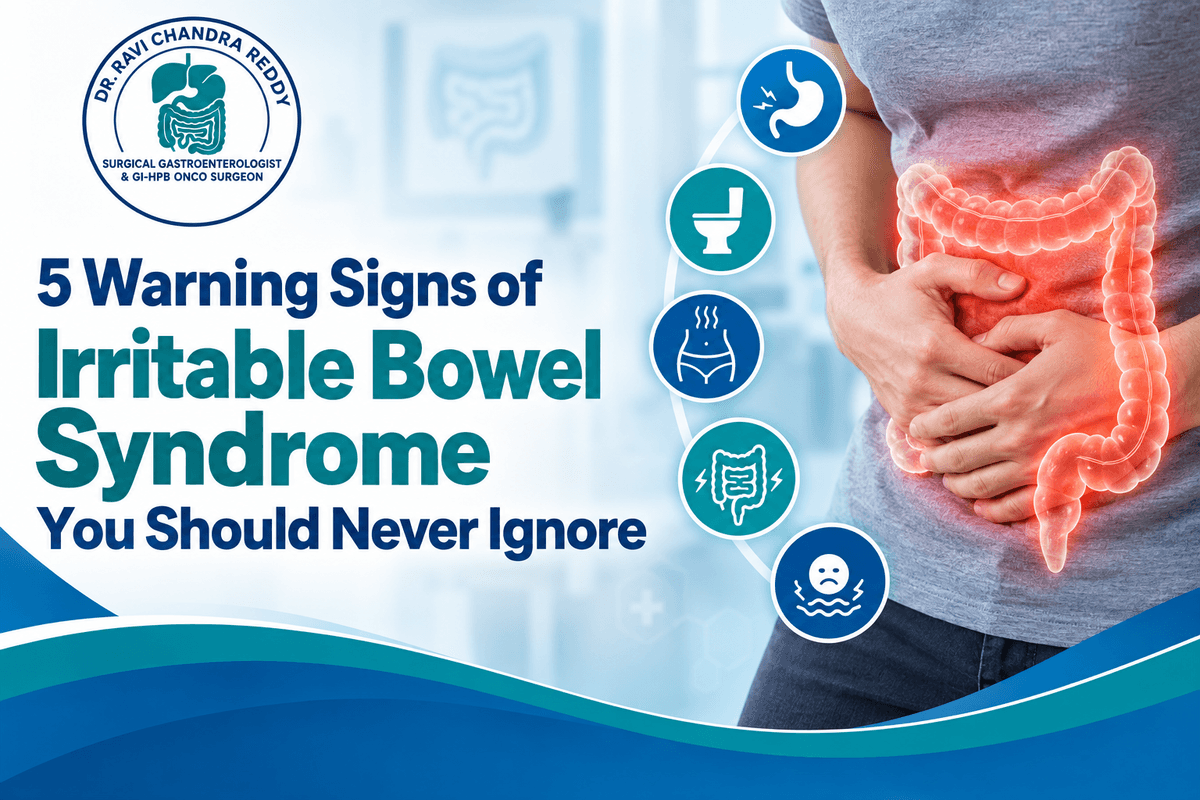
5 Warning Signs of Irritable Bowel Syndrome You Should Never Ignore
Is Your Stomach Trying to Tell You Something?
You've been bloated again after lunch. The cramping started somewhere between your third meeting and your commute home. By evening, you're rushing to the bathroom — or unable to go at all. You chalk it up to "bad food" or "stress." You tell yourself it will pass.
But what if it doesn't?
Many people across Visakhapatnam and the rest of Andhra Pradesh silently endure months — sometimes years — of recurring abdominal pain, unpredictable bowel habits, and persistent bloating before they ever speak to a doctor. The assumption is that these are ordinary digestive inconveniences. Sometimes they are. But when these symptoms repeat, cluster together, and begin to disrupt daily life, they may be pointing to a specific, diagnosable condition: Irritable Bowel Syndrome (IBS).
Knowing which signs to watch for — and when they cross the line from "annoying" to "medically significant" — can make a meaningful difference in how quickly you get the right care.
What Is IBS, and Why Does It Matter?
IBS is a functional gastrointestinal disorder characterised by chronic abdominal pain and altered bowel habits in the absence of an overtly identifiable structural cause. In simpler terms: your digestive system is sending distress signals, but routine scans and tests often show no obvious physical damage.
IBS is categorised as a disorder of gut-brain interaction, meaning there is a disconnection between how your brain and gut are communicating with each other.
Four subtypes of IBS are recognised: constipation-predominant IBS (IBS-C), diarrhea-predominant IBS (IBS-D), mixed IBS (IBS-M), and unsubtyped IBS. This variety is one reason IBS is so frequently misunderstood — it doesn't look the same in every person.
In India, the estimated prevalence of IBS is within the range of 4.0% to 7.9%, and this rate is steadily increasing. More importantly, only approximately 10–20% of IBS patients in India seek medical care, suggesting substantial underdiagnosis in the community.
That means a large number of people — possibly in your own neighbourhood in Krishna Nagar — are living with a manageable condition without ever receiving a proper diagnosis or a care plan.
The 5 Warning Signs of IBS You Should Never Ignore
⚠️ Warning Sign 1: Recurring Abdominal Pain That Changes With Bowel Movements
This is the cardinal feature of IBS. The Rome IV diagnostic criteria define IBS as recurrent abdominal pain on average at least one day per week in the last three months, associated with two or more of the following: related to defecation, associated with a change in frequency of stool, or associated with a change in form (appearance) of stool — with criteria fulfilled for the last three months and symptom onset at least six months prior to diagnosis.
If your stomach cramps seem to ease after a bowel movement, or if the pain consistently coincides with changes in how often or how you pass stool, that pattern deserves clinical attention — not just antacids.
⚠️ Warning Sign 2: Persistent Bloating and Excess Gas
Many people with IBS identify bloating as one of the most persistent and nagging symptoms of the disorder. This isn't ordinary post-meal fullness. It's the kind of distension that returns day after day, often in the afternoon or evening, and may feel worse with certain foods.
IBS causes uncomfortable abdominal symptoms, including constipation, diarrhea, gas, and bloating. When bloating appears alongside recurring pain or bowel changes — rather than as an isolated complaint — it becomes a meaningful piece of the clinical picture.
⚠️ Warning Sign 3: Alternating Constipation and Diarrhea
Perhaps the most disorienting sign of IBS is when your bowel habits swing between extremes. Some people with IBS experience mixed or alternating constipation and diarrhea (IBS-M), sometimes within the same bowel movement.
Accelerated bowel transit in IBS can result in a sudden, immediate urge to have a bowel movement, while constipation in IBS often causes a sensation of an incomplete bowel movement.
If you find yourself swinging unpredictably between days of urgency and days of straining, without a clear dietary or infectious cause, IBS should be part of the conversation with your gastroenterologist.
⚠️ Warning Sign 4: Mucus in Your Stool
The National Institute of Diabetes and Digestive and Kidney Diseases (NIDDK) notes that whitish mucus in stool can occur with IBS. Sensation of incomplete evacuation and fecal mucus have been found to be of increased prevalence in patients with IBS.
While small amounts of mucus in stool can be normal, mucus that contains blood points away from IBS and toward another cause, and any blood should be reported to a clinician even if you already carry an IBS diagnosis.
This brings us to the fifth and most critical sign.
⚠️ Warning Sign 5: "Red Flag" Symptoms — Rectal Bleeding, Unexplained Weight Loss, or Fever
These are the signs that must never be dismissed or self-managed.
IBS red flags include blood in the stool, unexplained weight loss, iron-deficiency anaemia, diarrhea that wakes you at night, a strong family history of bowel disease, or new symptoms after age 50.
Patients who meet Rome criteria for IBS but also present with warning signs are strongly advised to undergo colonoscopy to rule out severe colonic diseases such as inflammatory bowel disease (IBD) and colorectal cancer.
IBS is a functional disorder that does not cause internal bleeding. So if you see blood — whether bright red or dark and tarry — that is not your IBS. Seek immediate medical care if the bleeding is heavy or doesn't stop, or if you have symptoms like severe pain or dizziness alongside it.
How a Gastroenterologist Approaches IBS
The diagnosis of IBS is made by performing a careful review of the patient's symptoms, taking a thoughtful history including diet, medication, medical, surgical, and psychological history, evaluating the patient for the presence of warning signs such as "red flags" of anaemia, hematochezia, unintentional weight loss, or a family history of colorectal cancer or inflammatory bowel disease, performing a guided physical examination, and using the Rome IV criteria.
At his gastroenterology clinic in Krishna Nagar, Visakhapatnam, Dr. Ravi Chandra Reddy Obili conducts a structured clinical evaluation for each patient. This means that every assessment is tailored to your individual symptom history — not a generic checklist.
Since each person experiences different symptoms with IBS, everyone needs a treatment plan unique to them. Management typically spans multiple areas:
- Diet: The British Society of Gastroenterology guidelines suggest that dietary advice should be the first-line approach in the treatment of IBS. This may include a structured low-FODMAP trial, fibre adjustment, or identifying personal food triggers.
- Lifestyle: Managing IBS may involve identifying and avoiding dietary triggers such as FODMAPs, gluten, and gas-producing foods, as well as lifestyle changes such as stress reduction, regular exercise, and adequate sleep.
- Medication: Pharmacological treatment depends on the subtype of IBS. Your doctor will match any medication to your specific symptom pattern — whether pain, constipation, or diarrhea predominates.
- Gut-Brain Therapies: Because IBS is a disorder of gut-brain interaction, besides lifestyle changes, dietary advice, and drug treatment, psychotherapy is an important pillar in the treatment of IBS for appropriate patients.
Clinical Context: What the Evidence Says
IBS is the most prevalent disorder of brain-gut interactions, affecting between 5 and 10% of the general population worldwide.
IBS and anxiety are closely linked through the gut-brain axis, with around 40% of people with IBS also experiencing anxiety, depression, or panic symptoms. Stress and anxiety can make IBS symptoms worse, and discomfort in the GI tract can reinforce stress responses in the brain, leading to a self-reinforcing loop over time. This is why comprehensive IBS care must account for both physical and psychological dimensions.
The Rome IV criteria are frequently utilised in clinical practice and are accepted as the gold standard for IBS diagnosis. Using this framework, clinicians can accurately classify IBS subtypes and distinguish IBS from other gastrointestinal conditions that may present similarly — such as inflammatory bowel disease, celiac disease, or colorectal cancer.
IBS doesn't cause tissue damage in your gastrointestinal tract or increase your risk of more serious conditions, like colon cancer — but only once a proper clinical evaluation has ruled those conditions out. This is precisely why a structured, specialist-led assessment matters.
Frequently Asked Questions (FAQ)
Q1: What is the difference between IBS and IBD?
IBS and IBD are distinct conditions. IBS is a functional gastrointestinal disorder characterised by chronic abdominal pain and altered bowel habits in the absence of an overtly identifiable cause — meaning no structural damage is present. IBD, which includes Crohn's disease and ulcerative colitis, involves actual inflammation and damage to the bowel lining. In IBD, there are "alarm symptoms" such as fever, weight and appetite loss, bloody stool, vomiting, or anaemia, which are absent in IBS. If you have any of these alarm features, see a gastroenterologist promptly.
Q2: Can stress actually cause IBS symptoms?
Yes — through the gut-brain axis. Stress, altered gut microbiota, and hypersensitivity of the gut-brain axis can trigger and worsen both IBS symptoms and anxiety, creating a vicious cycle. Stress and anxiety activate the body's "fight-or-flight" response, which diverts resources away from normal digestive processes. Managing stress is therefore a clinical part of IBS management, not merely a lifestyle suggestion.
Q3: Is IBS a lifelong condition?
While your symptoms of IBS may come and go, the disorder often continues for a long time, even years. However, it's a chronic condition that most people can manage by changing their routines and what they eat, taking medications, and receiving behavioural therapy. Regular follow-up with a gastroenterologist — rather than self-management — helps ensure that symptoms are reviewed and that management remains appropriate over time.
Q4: When should someone in Visakhapatnam see a gastroenterologist for bowel problems?
You should seek a specialist evaluation if you have recurring abdominal pain that has lasted more than six months, unpredictable bowel habits, persistent bloating, or mucus in your stool. More urgently, red flags such as blood in the stool, unexplained weight loss, iron-deficiency anaemia, diarrhea that wakes you at night, or new symptoms after age 50 require prompt clinical review. Residents of Krishna Nagar and the surrounding areas of Visakhapatnam do not need to travel far — a gastroenterology consultation is available locally so that evaluation can begin without delay.
Q5: Are there foods that commonly trigger IBS symptoms?
Yes, though triggers vary significantly between individuals. Many individuals with IBS associate their symptoms with specific food intake, and dietary management has become a crucial aspect of IBS treatment, with initial recommendations focusing on adopting a healthy eating pattern and lifestyle. Common dietary triggers include FODMAPs, gluten, and gas-producing foods. A gastroenterologist or dietitian can help identify your personal triggers through a structured, supervised dietary assessment — rather than blanket food restriction, which can lead to nutritional deficiencies.
This blog is intended for general health information only and does not constitute medical advice. Please consult a qualified gastroenterologist for a clinical assessment of your symptoms.
Visit Us
Visit Ravi Chandra Reddy Obili - Gastroenterologist to discuss your care. We're here to help you and your family.
Ravi Chandra Reddy Obili - Gastroenterologist
Krishna Nagar, Visakhapatnam, Andhra Pradesh
Phone: 917337422216
Website: drravichandrareddygastrosurgeon.com
Google Maps: https://www.google.com/maps/place/?q=place_id:ChIJz1HwTwBpOToRjUbDE0b-PrM
Email: help@drravichandrareddygastrosurgeon.com